
Publications & Clinical Evidence
Most labs ask you to take their word for it. We'd rather show you the work. SoftCell testing is grounded in published, peer-reviewed research — including a registered, multicenter randomized controlled trial of 773 patients comparing PCR-guided and culture-guided management of complicated UTIs. Every study below links directly to its source. Read them closely. The results hold up. Call us to discuss what they mean for you and your patients.
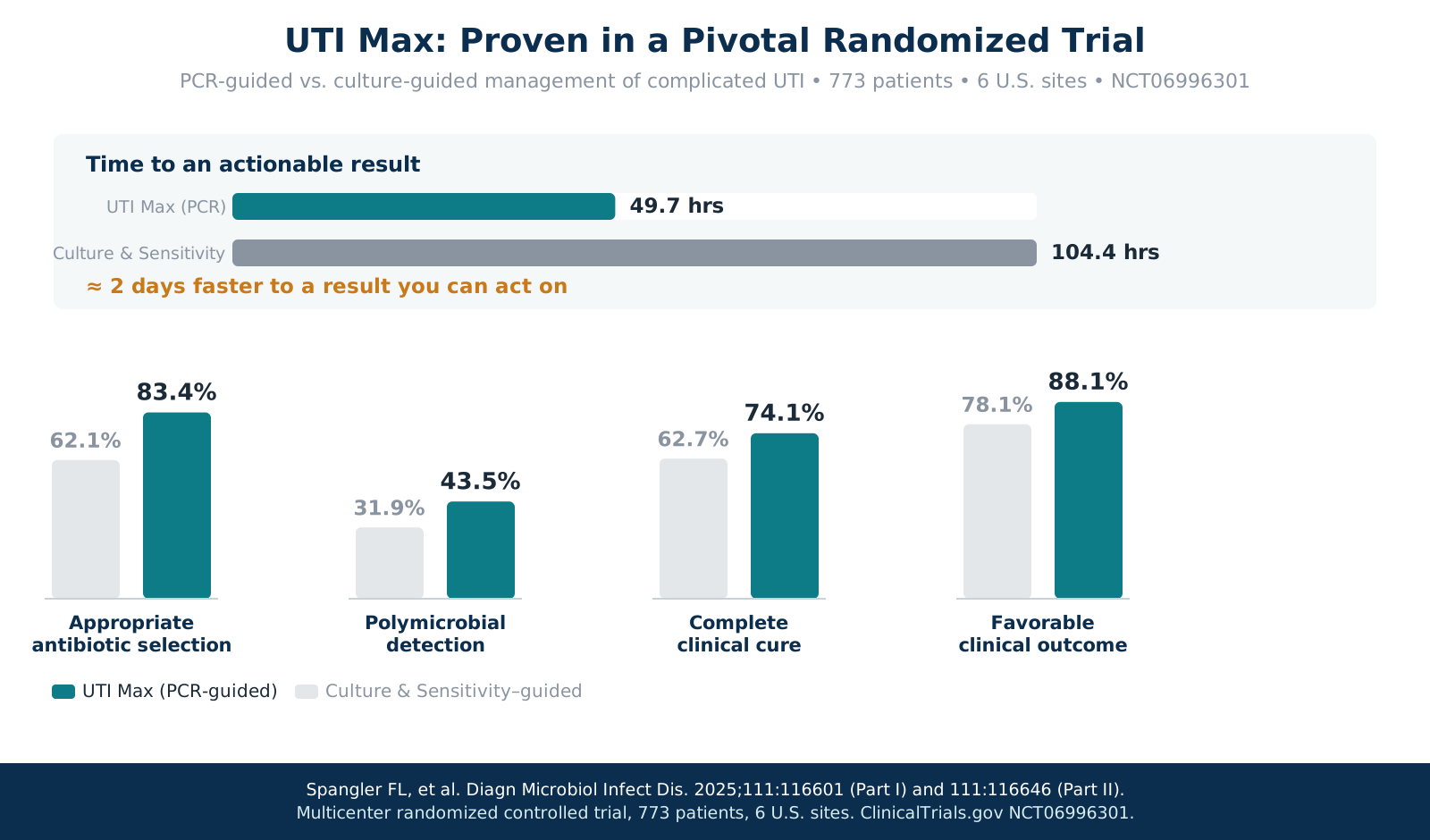
A Randomized Controlled Trial of PCR-Guided vs. Culture-Guided Care
773 Patients • 6 U.S. Sites • ClinicalTrials.gov NCT06996301
Adults with complicated UTI were randomized to management guided either by PCR or by conventional culture and sensitivity. Treating investigators acted on whichever result they received and were blinded to the comparator. PCR-guided management outperformed culture-guided management on speed, on detection, on antibiotic selection, and on whether patients actually recovered.
Stats:
Roughly 2 days faster to an actionable result — 49.7 hours vs. 104.4 hours (time from specimen collection)
43.5% polymicrobial detection vs. 31.9% with culture
83.4% appropriate antibiotic selection vs. 62.1% with culture
74.1% complete clinical cure vs. 62.7% with culture
88.1% favorable clinical outcome vs. 78.1% with culture
Published Research
Grouped by Study Type
Primary Trial Results
- Clinical utility of PCR compared to conventional culture and sensitivity testing for the management of complicated urinary tract infections in adults: Part I — Assessment of clinical outcomes, investigator satisfaction scores, and turnaround times.
Spangler FL, Williams C, Aberger ME, Wilson BA, Ajib K, Gholami SS, Goodwin HN, Park LY, Kardjadj M, Derrick D, et al.
Diagnostic Microbiology and Infectious Disease. 2025;111:116601.
DOI: 10.1016/j.diagmicrobio.2024.116601 · PMID: 39532029
What it found: PCR-guided management reached an actionable result in 49.7 hours versus 104.4 hours for culture, and produced higher rates of complete clinical cure (74.1% vs 62.7%) and favorable clinical outcomes (88.1% vs 78.1%).
- Clinical utility of PCR compared to conventional culture and sensitivity testing for management of complicated urinary tract infections in adults: Part II — Evaluation of diagnostic concordance, discordant results, and antimicrobial selection efficacy.
Spangler FL, Williams C, Aberger ME, Wilson BA, Ajib K, Gholami SS, Goodwin HN, Park LY, Kardjadj M, Derrick D, et al.
Diagnostic Microbiology and Infectious Disease. 2025;111:116646.
DOI: 10.1016/j.diagmicrobio.2024.116646 · PMID: 39671979
What it found: PCR detected polymicrobial infection in 43.5% of applicable cases versus 31.9% by culture, and supported appropriate antibiotic selection in 83.4% of cases versus 62.1% — an improvement of roughly a third.
Secondary and Ad Hoc Analyses
- The clinical validity and utility of PCR compared to conventional culture and sensitivity testing for the management of complicated urinary tract infections in adults: A secondary (ad hoc) analysis of pathogen detection, resistance profiles, and impact on clinical outcomes.
Kardjadj M, Chang TW, Chavez R, Derrick D, Spangler FL, Priestly IP, Park LY, Huard TK.
Microorganisms. 2025;13:949.
DOI: 10.3390/microorganisms13040949 · PMID: 40284785 · Open access
What it found: A deeper analysis of what PCR detected that culture did not, including resistance profiles and how those detections related to patient outcomes.
- Semi-Quantitative ΔCt Thresholds for Bacteriuria and Pre-Analytic Drivers of PCR–Culture Discordance in Complicated UTI: An Analysis of NCT06996301.
NCT06996301 study group.
Diagnostics. 2025;15(23):2959.
DOI: 10.3390/diagnostics15232959 · Open access
Read the full text in Diagnostics
What it found: Established semi-quantitative ΔCt thresholds that correlate with bacterial load, and identified the pre-analytic factors that drive disagreement between PCR and culture — addressing the common objection that molecular testing over-calls infection.
- Genotype–Phenotype Concordance and Ct-Informed Predictive Rules for Antimicrobial Resistance in Adult Patients with Complicated Urinary Tract Infections: Clinical and Stewardship Implications from the NCT06996301 Trial.
NCT06996301 study group.
Diagnostics. 2025;15(23):2945.
DOI: 10.3390/diagnostics15232945 · Open access
Read the full text in Diagnostics
What it found: Detected resistance genes corresponded to phenotypic resistance, supporting the use of molecular resistance markers to inform antibiotic selection and antimicrobial stewardship.
- Clinical Symptom Resolution Following PCR-Guided vs. Culture and Susceptibility-Guided Management of Complicated UTI: How Time-To-Antibiotic Start and Antibiotic Appropriateness Mediate the Benefit of Multiplex PCR — An Ad Hoc Analysis of NCT06996301.
NCT06996301 study group.
Diagnostics. 2025;15(24):3107.
DOI: 10.3390/diagnostics15243107 · Open access
Read the full text in Diagnostics
What it found: Examined why PCR-guided care produced better outcomes, finding that most of the benefit was mediated by faster time to antibiotic initiation, with improved antibiotic appropriateness contributing to a lesser degree.
Reviews and Commentary
- Evaluating the analytical validity and clinical utility and validity of polymerase chain reaction diagnostics vs culture and sensitivity methods in complicated urinary tract infection management: A comprehensive review of real-world evidence, clinical trials, and meta-analyses concerning Molecular Diagnostic Services Program coverage criteria.
Aberger ME, Wilson BA, Chavez R.
Reviews in Urology. 2025;24(1):1–11.
What it found: A review of the evidence base against MolDX Medicare coverage criteria, concluding that the real-world evidence demonstrates PCR's potential to meet several key MolDX requirements for reimbursement.
- Clinical Utility of PCR in Complicated Urinary Tract Infections: A Paradigm Shift in Diagnostics and Management.
Kardjadj M.
JU Open Plus. 2025;3:e00114.
DOI: 10.1097/JU9.0000000000000353
Read the full text in JU Open Plus
What it found: A perspective on how molecular diagnostics change the management of complicated UTI, situating the trial evidence in broader clinical practice.
Coverage and Reimbursement Evidence
For Health Plans, Contracting, and Utilization Review
For readers evaluating molecular UTI testing against coverage criteria, the review by Aberger, Wilson, and Chavez assesses the published evidence base specifically against Molecular Diagnostic Services Program (MolDX) criteria, drawing on real-world evidence, clinical trials, and meta-analyses.
Reviews in Urology 2025;24(1):1–11
Questions about coverage or contracting? Get in touch with our market access and commercialization team at info@SoftCellLabs.com or (503) 402-2505.
Evidence for Our Wider Test Menu
The publications above concern molecular testing for complicated urinary tract infection, which is where the clinical question was genuinely open and where we invested in a randomized trial. Our STI, vaginitis, respiratory, urinalysis, and pharmacogenomic testing use established, rigorously-validated molecular and clinical methodologies. We remain committed to advancing the evidence base through further and future studies across our test menu. Validation data for any test on our menu is available on request.